Signals and Systems

Figure 1 · section 4.6

Signals
and Systems.

A square wave is a sum of sine waves. Scroll, and its odd harmonics are added one at a time.

A low-pass system rounds its corners. The output is the input convolved with the impulse response.

In frequency the same system only scales each harmonic by |H(jω)|. Convolution became multiplication.
x(t)square wave · 1 of 25 odd harmonics
Signals and Systems · Figure 10%
8modules
531scenes
35laboratories
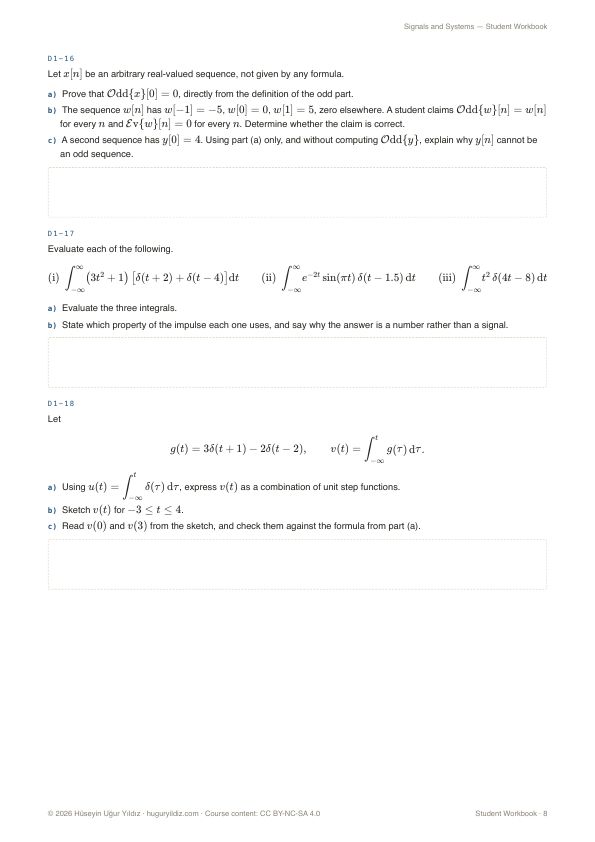
210worked questions

The course

Eight modules.

The first half describes signals and systems in time. The second half moves the same questions into frequency, where convolution becomes multiplication.

  1. 0

    Why signals and systems?

    What the course asks, and where its answers are used.

  2. 1

    Signals

    Energy and power, operations on the time axis, the impulse and the step, complex exponentials.

  3. 2

    Systems and their properties

    The six properties, and how to test a given system for each one.

  4. 3

    Linear time-invariant systems

    The impulse response, and convolution as a sum and as an integral.

  5. 4

    Fourier series

    A periodic signal as a sum of harmonics, and what an LTI system does to each one.

  6. 5

    The continuous-time Fourier transform

    The standard pairs, the properties, and systems described by a differential equation.

  7. 6

    The discrete-time Fourier transform

    The same questions for sequences, and systems described by a difference equation.

  8. 7

    Sampling and aliasing

    The sampling theorem, reconstruction, and aliasing where it happens in practice.

On paper

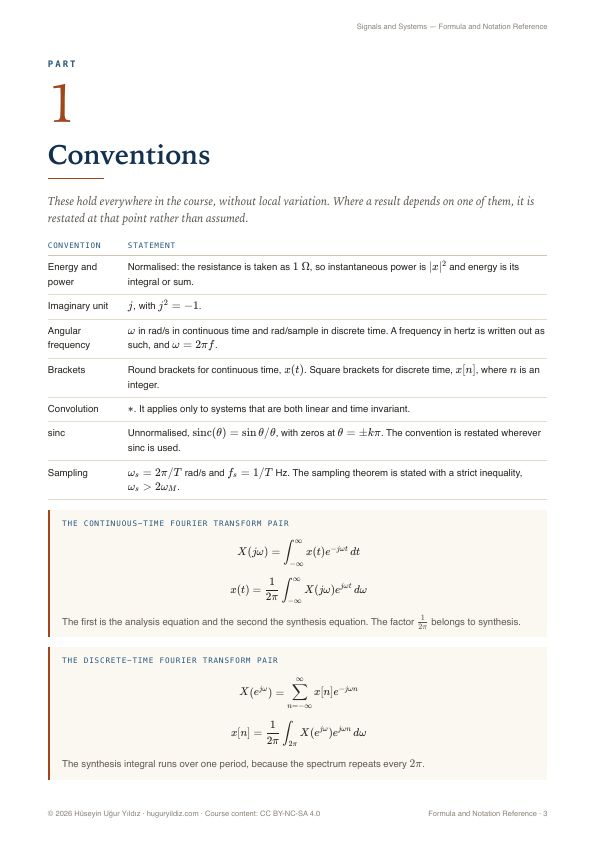
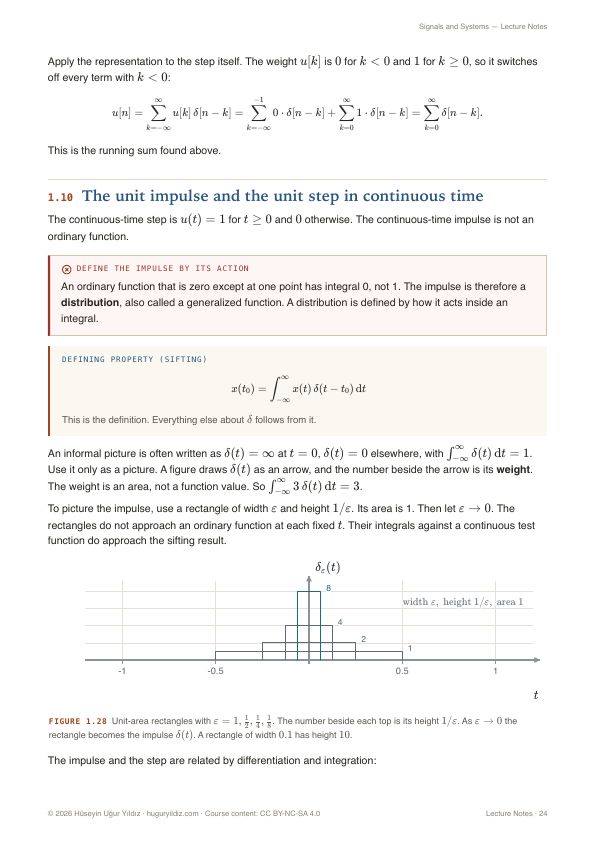
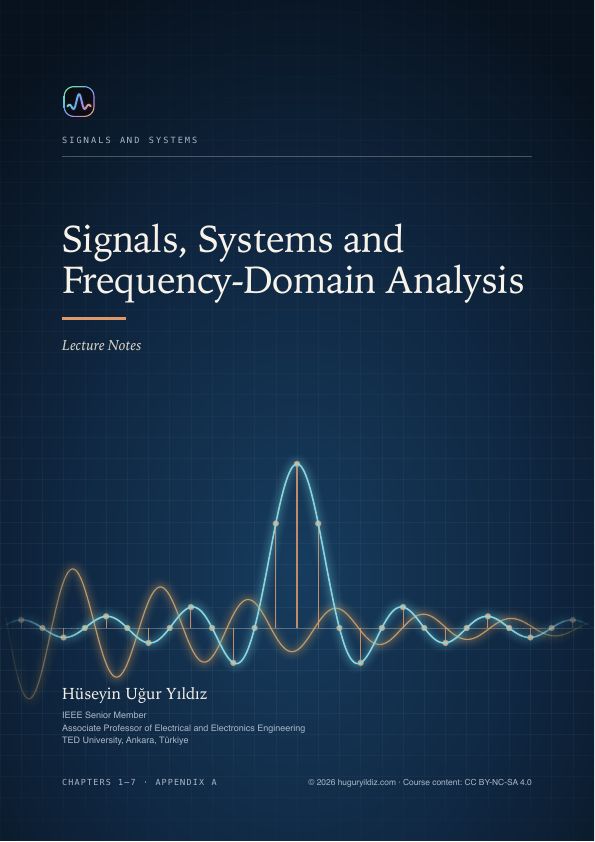
Three documents.

Typeset from the same sources as the course, as PDFs.